
Franklin County Court Records After Arrest
The Franklin County arrest-to-court path is unusually clear in the official county materials. The Franklin County courts page states that Justice Court handles traffic tickets from the State Highway Patrol and Franklin County Sheriff's Department, DUIs, county ordinance violations, and all felony cases for initial appearance and affidavit filing. It also states that Justice Court judges hold sessions at the jail three times each week to ensure an initial court appearance within three days of arrest.
That first appearance is not the same as a final criminal case record. After a Franklin County jail arrest, the booking side records custody, intake, bond, and release status. The court side records filed charges, case numbers, motions, hearing dates, dispositions, fines, and sentences. For custody and booking detail, use Franklin County jail inmate records. For booking photographs, use Franklin County jail mugshots. Court records after arrest are the place to track what the state actually files and proves.
Franklin County's Circuit Court has original jurisdiction over civil and criminal matters not vested exclusively in another court, and most Circuit Court cases are heard by juries. Felony matters may begin in Justice Court and move into Circuit Court after prosecutor review, information, or indictment.
Find Court Records After Arrest
The court records search should start with the name and details from the arrest, then move to the clerk or state case system. The Franklin County Circuit Clerk page names Warren Walker as Circuit Clerk and states that the office receives and files lawsuits, indictments, motions, and related papers in civil and criminal cases. Circuit Clerk contact is P.O. Box 267, 36 Main Street, Meadville, MS 39653, circuitclerk@franklincountyms.org, and 601-384-2320.
- Confirm the person's full legal name, date of birth if known, arrest date, and arresting agency from the jail or arrest paperwork.
- Check whether the matter is still at the Justice Court stage by calling 601-384-2002 for initial appearance, affidavit, traffic, DUI, or lower-court questions.
- Contact the Circuit Clerk when a felony case, indictment, motion, or Circuit Court criminal filing may exist.
- Use Mississippi Electronic Courts for case-management access where registration and portal rules permit.
- Read each court record by charge, status, filing date, and disposition rather than assuming the booking charge is final.
The Circuit Clerk screenshot from Franklin County's official Circuit Clerk page documents the local office used for criminal filings after many jail arrests.
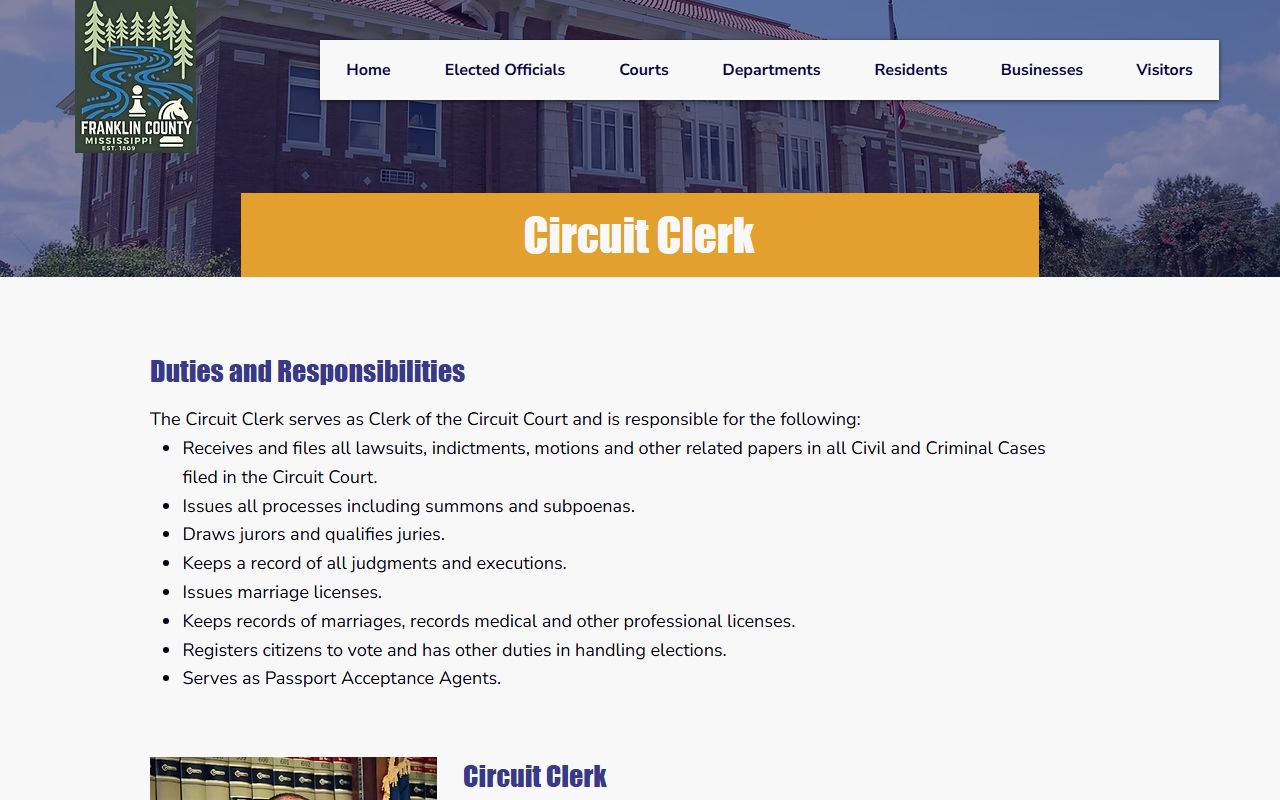
The clerk contact is especially important when an older case, limited record, or non-public portal item requires direct staff handling.
Franklin County MEC Search Fields
Mississippi Electronic Courts is the statewide electronic filing and case-management environment for trial-court records. Access may depend on account registration and portal workflow, and Justice Court records may still require local clerk contact. For Franklin County court records after a jail arrest, MEC and clerk access should be used to verify filed charges and case status, not to replace the jail's custody confirmation.
| Field Label | Type | Required | Options or Notes |
|---|---|---|---|
| MEC account/login | registration/login | Likely for full access | Mississippi Judiciary describes MEC as electronic filing and case management. |
| Defendant name | case-search field | Unspecified | Use the full legal name from booking or arrest paperwork. |
| Case number | case-search field | Optional if known | Ask the jail or clerk after filing if no case number is known. |
| County/court | selector or filter | Unspecified | Use Franklin County and the correct court level. |
| Clerk counter/mail | in-person or mail | n/a | Use the Circuit Clerk for criminal filings and records that are not easy to reach through MEC. |
The Mississippi Electronic Courts portal screenshot shows the statewide case-access environment relevant to Franklin County Circuit Court records after arrest.
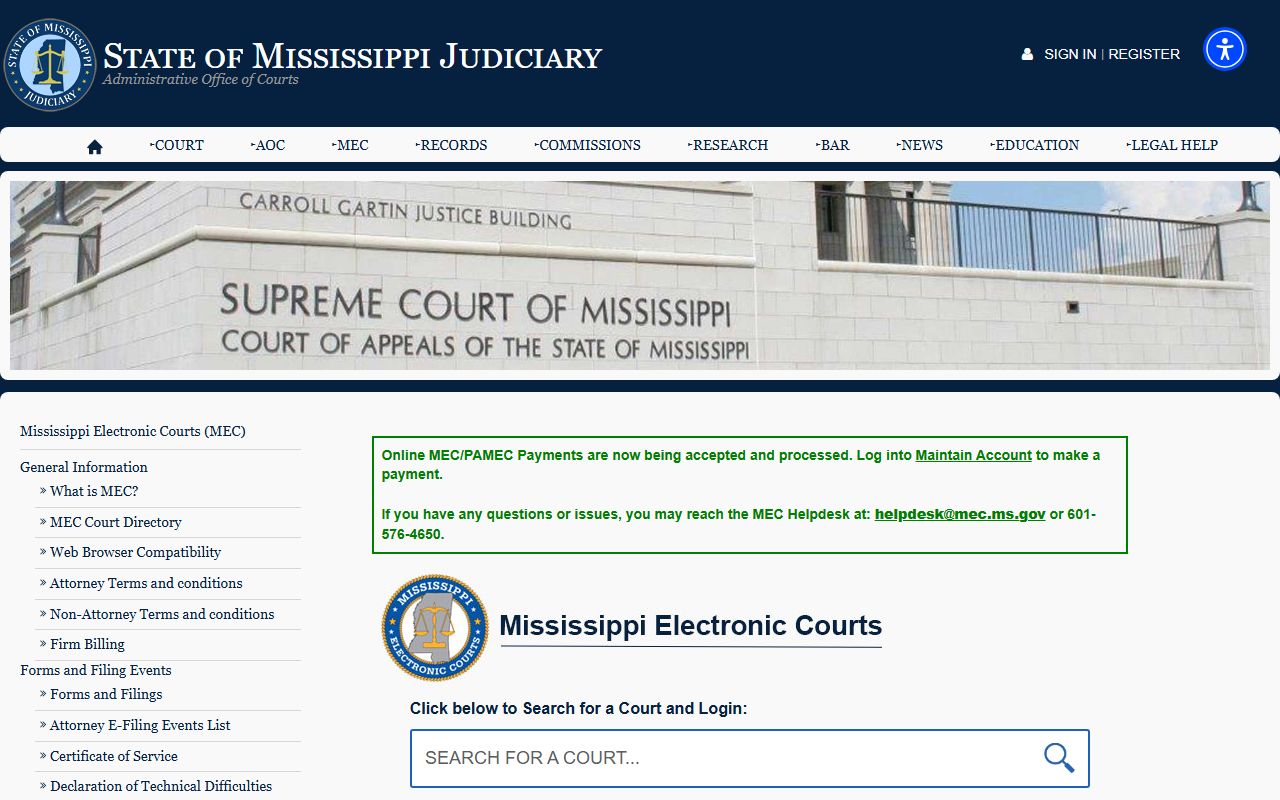
Portal access helps with filed case data, while jail staff and clerks still control many current custody and local scheduling details.
Charging Documents After Arrest
A charge in a Franklin County booking record can differ from the charge that appears later in court. The arresting agency may book a person on an initial allegation. The County Prosecuting Attorney or District Attorney may then review facts, file a complaint or information, reduce or add counts, dismiss a count, or present a matter to a grand jury. The District Attorney page names Tim Cotton and says the office prosecutes felony, misdemeanor, and juvenile cases in Franklin County.
| Document | Who Uses It | Practical Meaning |
|---|---|---|
| Complaint or affidavit | Officer, complainant, or prosecutor at an early stage | Starts or supports a lower-court case or initial felony proceeding. |
| Information | Prosecutor | Formal prosecutor-filed charge when procedure allows it. |
| Indictment | Grand jury | Formal felony charge after grand-jury action. |
The Franklin County District Attorney page screenshot identifies the state prosecutor role behind many court records after a jail arrest.
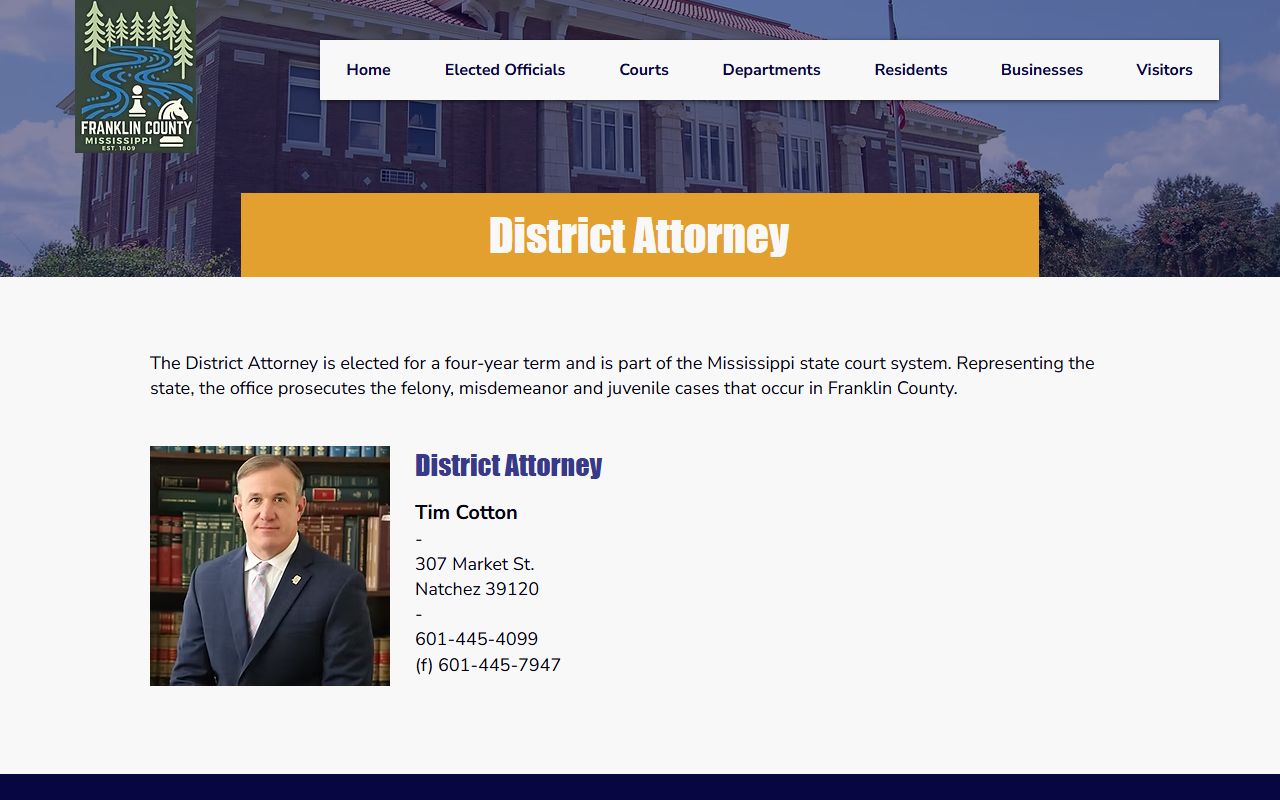
That prosecutorial layer is why a jail booking charge should be checked against the later court record before drawing conclusions.
Franklin County Charge Status
Charge status shows where the court record stands after an arrest. A pending count is still unresolved. An amended or reduced count means the filed charge changed. A dismissal means the count did not proceed to conviction. A disposition is the court's outcome, such as plea, verdict, dismissal, sentence, or other final action. These terms should be read charge by charge because one case may have several counts with different outcomes.
| Status | What It Means | Why It Matters |
|---|---|---|
| Pending | The court has not entered a final outcome. | Future hearings, bond conditions, or filings may still change the record. |
| Amended or reduced | The prosecutor or court changed the filed charge. | The original booking charge may no longer match the case record. |
| Dismissed | The count did not proceed as a conviction. | Dismissal does not automatically erase all public records. |
| Nolle prosequi | The prosecutor declines to pursue a charge at that time. | Local procedure and court order control what remains public. |
| Convicted | A plea or verdict resulted in guilt on that count. | Sentence, fines, probation, jail, or prison may follow. |
Note: A booking charge is an accusation at intake. A conviction is a court outcome after plea or proof.
Bond After Franklin County Arrest
Bond links jail records and court records. The sheriff page states that jailers collect money for fines and bonds, but it does not publish a payment vendor, bond window hours, accepted payment methods, or bond schedule. The court page supplies the court checkpoint: felony matters first go to Justice Court for initial appearance and affidavit filing, and judges hold jail sessions three times weekly. Bond may be set, changed, denied, or affected by a hold at that stage.
| Bond Type | How It Works | Franklin County Caution |
|---|---|---|
| Cash bond | Money is paid directly to secure release under court terms. | Call the sheriff before arrival to confirm accepted payment method. |
| Surety bond | A bail agent posts surety for a fee. | Confirm the court permits surety for the specific case. |
| Personal recognizance | Release is based on a promise to appear, often with conditions. | Set by a judge, not by jail staff alone. |
| No-bond hold | A court or agency hold prevents release by ordinary payment. | Ask about warrants, probation/parole holds, ICE detainers, DOC holds, or federal holds. |
Warrants and Court Records
No official Franklin County active warrant search, warrant list, or most-wanted page was located. The sheriff page says the sheriff serves process papers and executes warrants, while the courts page describes criminal affidavits and arrests after probable cause. A warrant can lead to jail booking, but an active warrant may not appear in a public Franklin County online database.
For warrant questions, call the Franklin County Sheriff's Office at 601-384-2323, Justice Court at 601-384-2002, or the Circuit Clerk at 601-384-2320 depending on the stage. A person with an active warrant may be arrested when appearing in person, so call first. Search warrants and active investigative materials may be restricted even when incident reports or court filings are public.
Charges vs Convictions
Franklin County court records after a jail arrest should be read with a clear distinction between a charge and a conviction. An arrest or filed charge means the state alleges an offense. A conviction means a court accepted a guilty plea or entered a guilty verdict. The difference affects how the record should be interpreted, especially if a case is pending, dismissed, amended, or reduced.
| Comparison Point | Charge | Conviction |
|---|---|---|
| Stage | Accusation after arrest or prosecutor filing. | Final or resolved court outcome by plea or verdict. |
| Proof level | Based on probable cause or filing standards. | Requires plea or proof beyond a reasonable doubt. |
| Record meaning | May change, be dismissed, or be reduced. | Can carry sentence, fine, probation, jail, or prison consequences. |
Sealed and Expunged Records
Mississippi public-records law generally favors access to non-exempt public records, but some Franklin County court records after arrest can be withheld from public view. Juvenile matters, sealed records, expunged records, victim-identifying information, and protected investigative files may be restricted. An expungement or sealing issue should be handled through the court order and the agency that maintains the record.
| Comparison Point | Sealed | Expunged |
|---|---|---|
| Public visibility | Hidden from ordinary public access by court rule or order. | Removed or treated as cleared under the controlling court order. |
| Agency handling | Some authorized users may still have limited access. | Agencies must follow the expungement order and related law. |
| Best next step | Ask the clerk what order controls access. | Use the signed order when contacting the court, sheriff, or other record holder. |
Important: A dismissal or release from jail does not automatically erase every court, jail, incident, or prosecutor record.
Public Access Limits After Arrest
The Mississippi Public Records Act defines public records broadly and states that public bodies must provide reasonable access to non-exempt records. It also says denials should be written and cite the exemption. For law-enforcement material, Mississippi treats incident reports as public records but allows protection for investigative reports and victim-identifying information. Fees may cover actual search, review, redaction, duplication, and mailing costs.
The Public Records Act screenshot at the Mississippi Ethics Commission Public Records Act page supplies the state access framework for Franklin County court and jail record requests.
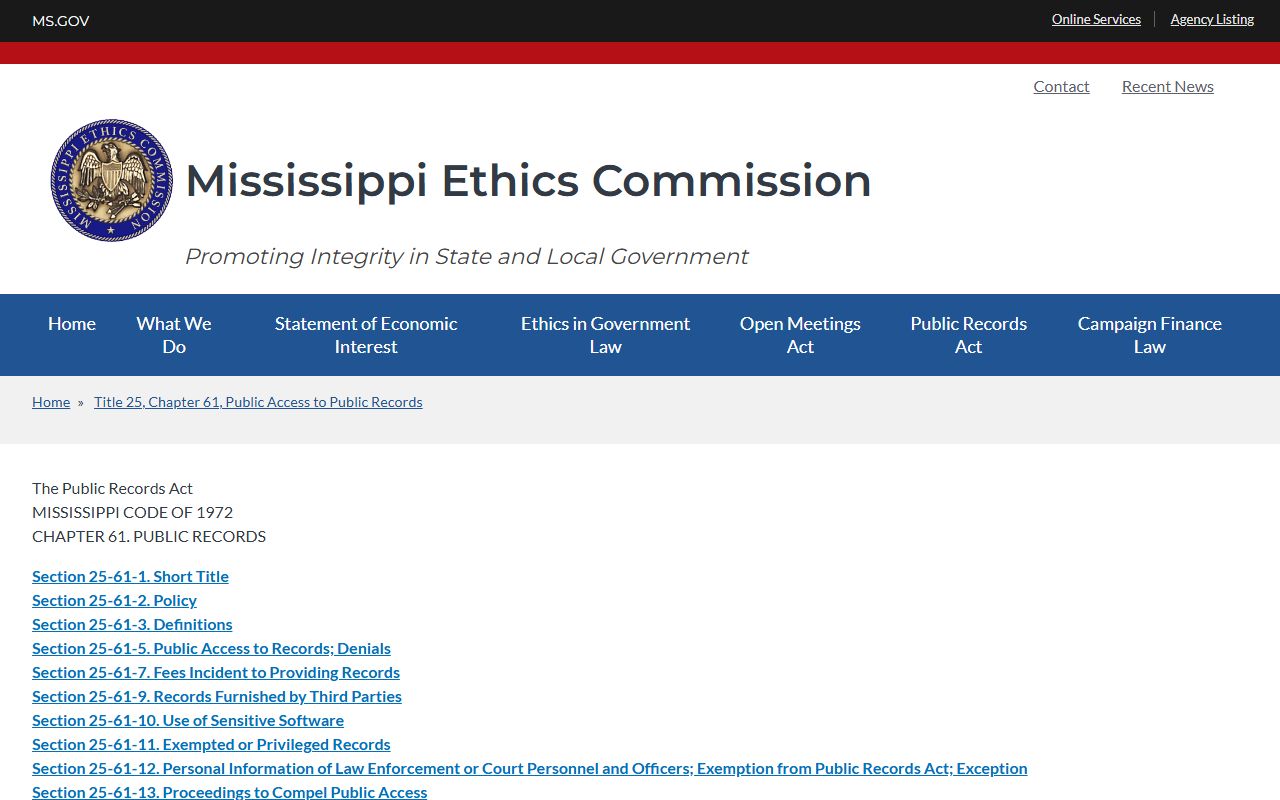
That law helps frame requests, but the clerk, court order, and agency-specific exemptions still determine what can be released.